AI Image Generation: Real vs. Fake in the Digital Age
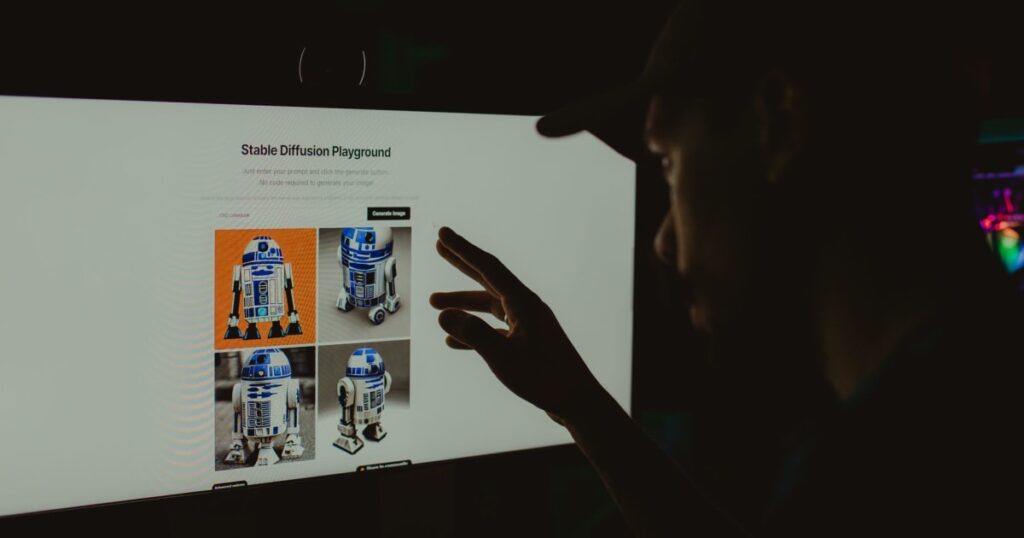 Take a quick scroll through your feed right now. A girl sipping coffee in peace, a short reel of a smart pup, a blog post featured image, a YouTube thumbnail… Are you 100% sure you can tell what’s real and what’s cooked up by AI?” Seeing is believing” used to be the golden rule, but generative AI has practically thrown that out the window. Flawless, poreless skin, waxy plastic finishes, and uncanny-valley cartoonish details are dead giveaways: AI is everywhere, seeping into every corner of our digital lives.
The “democratization” of AI has paved the way for an era of tech abuse. Pumping out an artwork takes a mere 2 to 5 minutes, cheapening the value of genuine creativity. While the world lost its collective mind in 2023 when Boris Eldagsen’s AI piece snatched the top prize at the Sony World Photography Awards, fast forward to today: tools like OpenAI’s Sora and Google’s Veo operate with mind-bending internal physics engines. They understand exactly how light refracts through a crystal glass, how fabric realistically folds with a human step, and how microscopic dust particles dance in a sunlit room.

When reality can be mass-manufactured on an industrial scale, the fallout is massive. In this deep dive, The Lab is going to rip off the band-aid on the real-vs.-fake matrix: from the psychological impact on the masses and the “Liar’s Dividend” phenomenon to the hardcore mathematical architecture of diffusion models. We’ll expose exactly why current AI detectors are basically flipping a coin. But more importantly, The Lab wants to show you the silver lining—the massive opportunities for creators and brands in the emerging trust economy.
Can You Spot the Difference Between Human Art and AI Outputs?
Pop Quiz: Which One is the Real Deal?
Before we geek out on how these models work, let’s put your eyes to the test. Three of the images below are AI-generated (Canva, ChatGPT, and Gemini), and one is a legit, raw photo from Pexels. Can you spot the real one?




This is a fun personal experiment. If you spotted any other glitches, drop a comment below!
Here’s a streamlined, bulletproof checklist from a buddy of mine who works as an AI trainer, so you can borrow their exact workflow and level up your fake-radar:
The Ultimate AI Trainer Checklist:
| Level | What the Pro Does | Things to Scrutinize | The Goal |
| Level 1 – Quick Glance (5–10s) | Scan the whole image for glaring glitches before zooming in. | Text gibberish, mangled hands/fingers, melted background people, weird repeating patterns. | Spot the most obvious, sloppy AI tells. |
| Level 2 – Consistency Check (15–30s) | Zoom in on glitch-prone areas and cross-reference physics. | Asymmetrical jewelry/glasses, contact points (hands holding a cup), lighting/shadows, reflections on glass/water/metal. | Catch the geometrical and physics fails that AI still struggles with. |
| Level 3 – Source Verification | Vet the origin before trusting the pixels. | Who posted it? Is it a journalist, a photographer, or an anon account? Any clear date, location, or context? | Judge the source’s credibility instead of relying solely on the visual. |
| Level 4 – Cross-Checking | Bounce the image against independent sources. | Run Google Lens or TinEye. Find the original version. Compare with other news outlets. | See if the image is recycled, photoshopped, or taken totally out of context. |
| Level 5 – Holistic Evaluation | Compile all your evidence before making a call. | Don’t obsess over one single glitch. Don’t blindly trust AI detectors. Combine visual clues + source check + cross-verification. | Make a probability-based call instead of a hard “100% AI” or “100% Real.” |
(Note: The framework above is pulled from the daily grind of AI trainers, digital forensics experts, OSINT squads like Bellingcat, and top-tier newsrooms. Their golden rule is simple: never base your verdict on a single clue or a single automated detection tool. Layer your evidence.)
The Science Behind Our “Fake Radar”
When it comes to humanity’s collective ability to tell hyperrealistic AI apart from raw photos, global studies show our visual radar is all over the place:
-
The “Coin Toss” Odds: A study on arXiv (“Seeing isn’t always believing”) revealed that humans correctly identify synthetic images only 61.3% of the time. But here’s the kicker: individual performance varies wildly. Top performers hit 73%, while others tanked at a dismal 40%. Sadly, the fear of being duped is so intense that people are gaslighting themselves—looking at a real photo and hallucinating AI glitches that aren’t there.
-
The Massive Microsoft Trial: In a massive online survey testing 287,000 views from 12,500 people, Microsoft found that human accuracy hovered right around that 63% baseline, while their proprietary internal tools hit 95%.
-
The “Take Your Time” Counter-Argument: A massive MIT study (presented at CHI 2022) with over 50,000 participants dropped a crucial caveat. When people actually slowed down and scrutinized the details instead of doomscrolling, their accuracy shot up to about 83%.
Long story short: our habit of speed-scrolling through social media feeds starves our brains of the time needed for deep visual analysis.
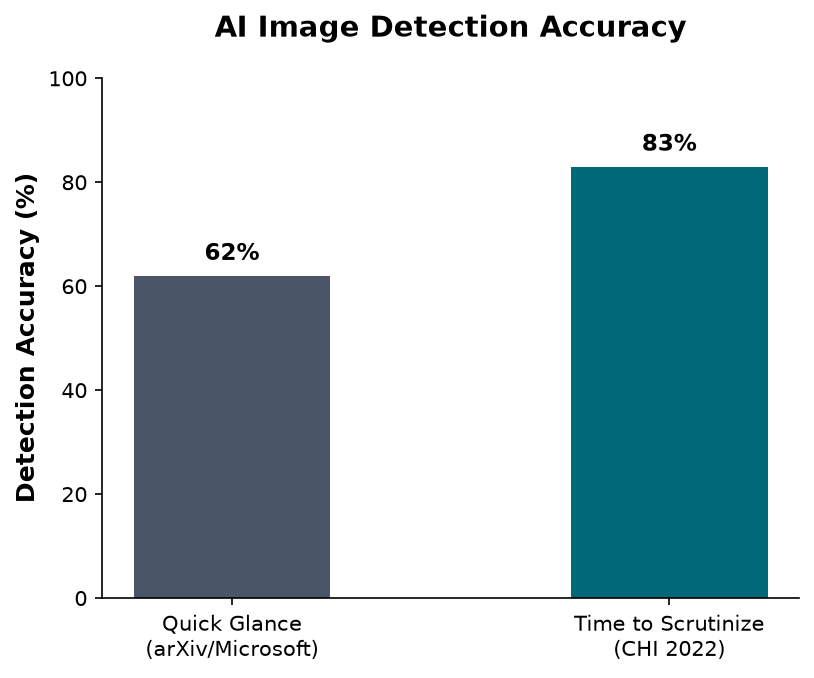
A data visualization comparing human accuracy in detecting AI images. Accuracy sits at a mere 62% during a quick social media scroll but jumps significantly to 83% when viewers take the time to scrutinize the visual details.
How AI Paints Reality Out of Pure Static
The structural difference between a real photo, a Photoshopped image, and an AI generation boils down to the hardcore math of the algorithm.
| Criteria | Traditional Software (Photoshop) | Generative AI Models (Diffusion) |
| Core Mechanism | Local pixel manipulation (cutting, pasting, stretching existing pixels). | Simultaneous mathematical denoising. |
| Input State | Existing image files with physical structure. | A frame of random white static (Gaussian noise). |
| Processing Method | Linear transformation (leaves sloppy digital seams/edges). | Synchronized restoration of geometry, light, and texture via multiple iterations. |
| Texture Characteristics | Digital seams, natural film grain. | Absolutely seamless, resulting in a waxy/plastic look due to the lack of raw, gritty texture. |
By building the entire composition from a primordial soup of noise, diffusion models completely bypass the usual physical editing footprints. This absolute uniformity results in that unreal, ultra-smooth finish—which is our main technical breadcrumb for setting up detection filters.
From “Epistemic Backstop” to the “Liar’s Dividend” Trap
Looking back at media history, photos and audio recordings have long served as the ultimate “epistemic backstop” of human civilization. In her philosophical essay Deepfakes and the Epistemic Backstop, philosopher Regina Rini argues that when testimonies clash, audiovisual evidence has always been the supreme referee to settle the score.
When the Liar Plays the Victim
Think AI is just for churning out fake news? The reality is much darker: AI is being weaponized to assassinate existing truths.
Scholars Bobby Chesney and Danielle Citron coined this the “Liar’s Dividend.” The mechanics are brutally simple: When the public knows AI can fake reality with 100% accuracy, anyone caught red-handed in a leaked bribery video, an explicit audio recording, or illegal surveillance footage can just shrug it off and say, “It wasn’t me; it’s an AI deepfake.”
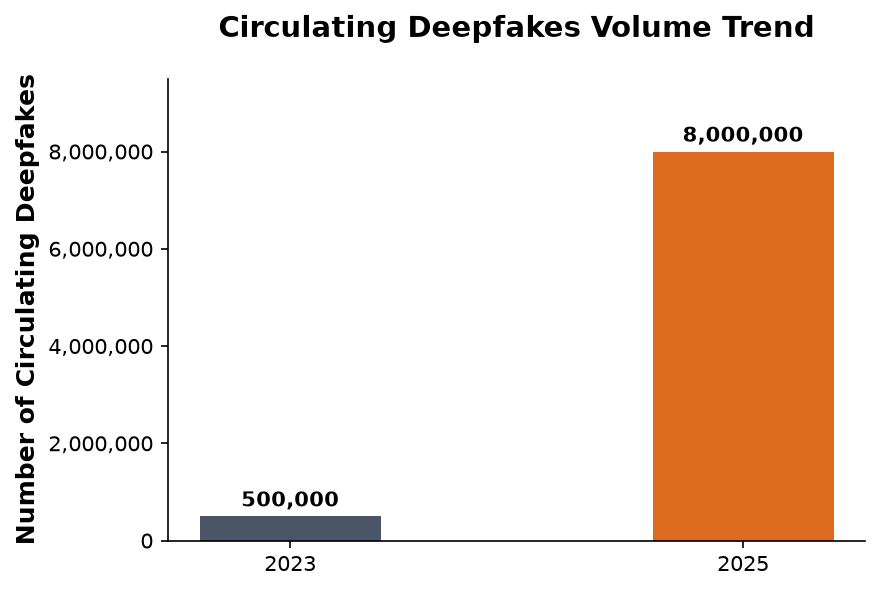
According to Resemble AI’s 2025 Deepfake Threat Report, this erosion of trust is triggering an unprecedented “evidence crisis,” with financial fraud and defamation damages clocking in at $1.28 billion. Even scarier, deepfakes hit “industrial scale” during the early 2026 election cycle. Fake political ads—like the AI hit job targeting Texas Senate candidate James Talarico that went viral on X in March 2026, or when Punjab Chief Minister Bhagwant Mann immediately used the “AI smear campaign” excuse to dodge a scandalous video before facing forensic forgery charges—have flooded the zone, leaving the public completely lost in a sea of algorithms.
Faced with this chaos, historical skeptics try to cool the panic by calling it “old wine in a new bottle.” They point out that Soviet darkroom techs used to literally scrape purged politicians out of photos with scalpels and that Photoshop’s 1990 debut sparked the exact same “photography is dead” hysteria. They argue that our trust has always relied on the publisher’s institutional reputation, not the individual pixels.
But this comforting historical parallel totally misses the unique, existential threat of the generative revolution: the unprecedented asymmetry in scale and velocity. While the darkroom and Photoshop eras required elite experts and hours of expensive manual labor, generative AI lets literally anyone automate lies. It happens in seconds, with a marginal cost hovering near zero. This isn’t just a tech evolution; it’s the “democratization” of fraud on an industrial scale.
When the “AI Ghost” Challenges the Justice System: The Tesla Case
This terrifying shift officially jumped from the Twitter timeline straight into the courtroom via the bombshell autonomous driving wrongful death lawsuit: Walter Huang v. Tesla Inc. (Santa Clara Superior Court).
In this legal brawl, Tesla’s defense team tried to argue that a 2016 video and audio recording of Elon Musk boasting about Autopilot’s safety… could very well be an unverified deepfake and therefore shouldn’t be used as evidence to drag Musk to the witness stand.
Judge Evette Pennypacker instantly shot down this defense, slamming Tesla’s strategy as “deeply troubling.” She delivered a blistering warning: Tesla’s argument was paving the way for a highly toxic legal precedent, allowing powerful figures to completely dodge accountability for their public statements by simply hiding behind the “ghost” of generative AI.
Epistemic Collapse and the “Systemic Apathy” Mechanism
The darkest, long-term fallout of this cycle isn’t just that people believe fake news—it’s that it shoves society into an “epistemic collapse.”
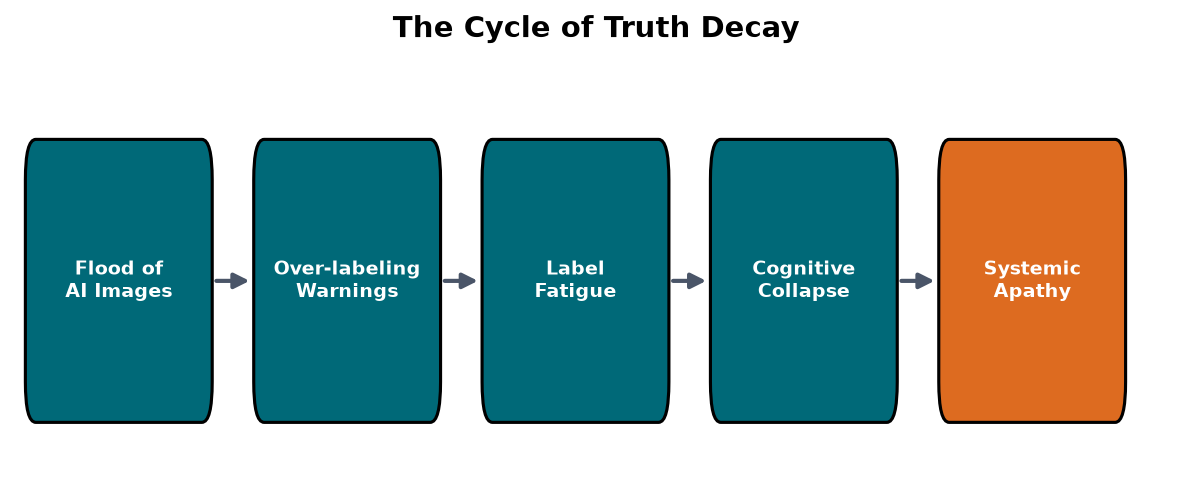
According to a European Parliament (EPRS) report citing Europol, synthetic content could soon swallow 90% of the public internet. To fight back, tech platforms slap automated warning labels on everything. This well-intentioned overcorrection triggers label fatigue—bombarded by warnings, users start ignoring them completely, spiraling into cognitive paralysis. They don’t just doubt the lies; they lose all faith in their ability to identify the truth.
This intellectual burnout plants the seeds for “truth decay,” pushing the public into a toxic defense mechanism: systemic apathy. When digging for the truth takes too much brainpower, people just give up. They retreat into their pre-existing biases, let emotions hijack their worldview, and instantly reject any new information. This perfectly explains why the digital generation is suddenly pivoting back to physical touchpoints like printed docs and Polaroid film to find a raw, unhackable truth.
Why “AI Scanners” Are Waving the White Flag
A lot of companies and newsrooms initially treated automated AI detectors as a magic bullet for fake news. But from a mathematical standpoint, it’s a rigged game.
As analyzed above, AI images generated by diffusion models are seamlessly “cast in one piece,” devoid of digital cracks. Asking a scanner to catch AI is like looking for glue marks on a statue carved from a single block of marble. This tech impotence was laid bare when OpenAI quietly killed off its own AI classifier because it was hitting rock bottom with a 26% accuracy rate. Using algorithms to play catch-up and bust other algorithms is a fool’s errand.
(Insert detector vs. generator loop chart here)
Caption: The Generative Arms Race: Structural disadvantages dictate that AI detection algorithms will always remain one step behind AI generation models.
Head-to-Head: The Top Detection Tools Today
Despite non-stop updates, the market’s top filters all have fatal Achilles’ heels:
| Tool Name | Core Mechanism | Real-World Limitation |
| Google Lens / TinEye | Reverse image search to track down the source or debunked context. | Can’t analyze physical structure; relies 100% on previously indexed data. |
| Hive Moderation | Enterprise-grade AI signal scanning. | Requires a pricey subscription; easily bypassed if the file is heavily compressed. |
| Illuminati | Spectral analysis to hunt for diffusion noise. | Highly prone to false positives on real photos heavily color-graded by photographers. |
| Google SynthID | Embeds an invisible digital watermark directly into the pixel structure at creation. | Only works on images born from compatible models (like Imagen); completely blind to rogue open-source models. |
The C2PA Shield and a Harsh Reality Check
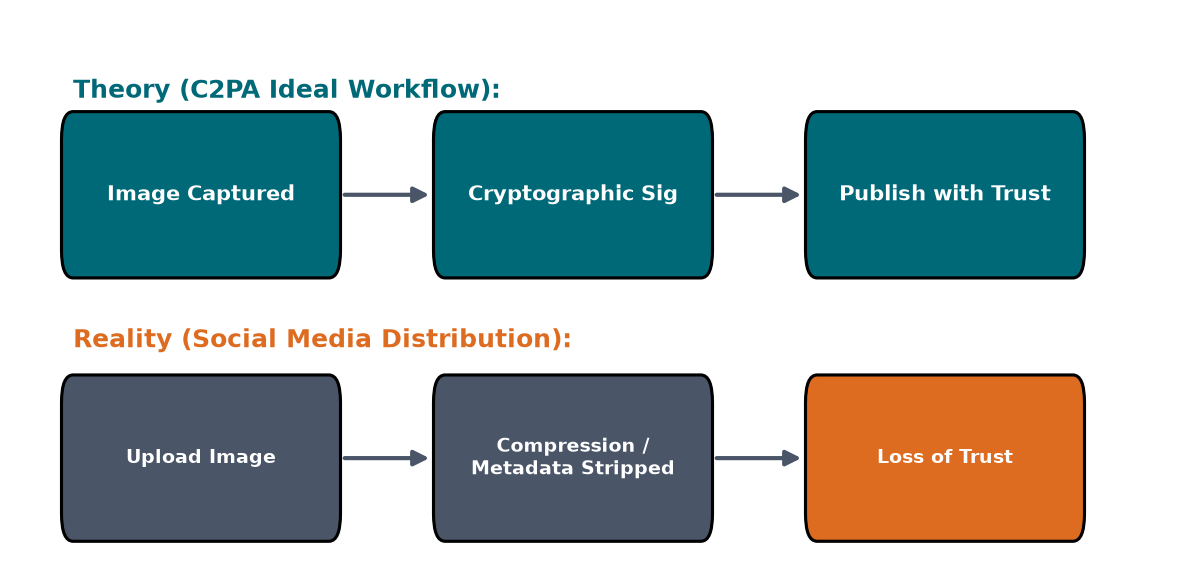
To fix the detector failure, a global tech coalition rolled out the C2PA (Coalition for Content Provenance and Authenticity) standard. Instead of trying to “detect” AI, C2PA acts like a digital wax seal attached to the image’s metadata.
Even though camera heavyweights like Leica, Sony, and Canon are baking this into their hardware, this architecture of trust gets completely shredded by two massive loopholes:
-
Social Media Compression Algorithms: When a pristine, C2PA-verified photo gets uploaded to Meta, X, or TikTok, their optimization engines nuke the metadata to save file size. The cryptographic signature is tossed in the trash without a second thought.
-
The “Analog Loophole” (Screenshots): This is the kill shot. A troll spreading fake news just has to open a verified photo on their monitor, snap a pic with their phone, or use the Snipping Tool. The new image looks identical, but the C2PA “wax seal” evaporates instantly.
That’s exactly why Reuters Institute data reveals a grim reality: less than 1% of global news images and videos currently reach a reader’s screen with their C2PA provenance intact. Tech defense, at the end of the day, is still lagging miles behind algorithmic chaos.
(Insert C2PA Analog Loophole Chart here)
Caption: Theory vs. Reality: A flowchart demonstrating how social media compression algorithms and the “analog loophole” (screenshots) instantly destroy cryptographic C2PA signatures.
When the Law Steps In: A Legal Shield for the Digital Age
When technical barricades like C2PA keep failing, legislation becomes the last line of defense to restore order online.
In the US, state and federal lawmakers are scrambling to criminalize the malicious, non-consensual distribution of deepfakes. Globally, the EU AI Act drops the hammer with the strictest transparency regulations and penalties for generative AI mega-corps. Meanwhile, South Korea has spearheaded aggressive legal crackdowns on deepfake crime, slapping severe prison sentences on both the creators and the distributors.
The Deepfake Survival Guide for Victims
If you or your brand get caught in the crosshairs of a malicious deepfake smear campaign, the first few hours are make-or-break:
-
Preserve the Evidence: Immediately take screenshots, screen record, and back up all URLs containing the fake content for future legal probes.
-
Trigger Emergency Takedowns: Thanks to new legal frameworks, major platforms like Meta, Google, and TikTok now have 24-48-hour emergency response channels for non-consensual synthetic media.
-
Hit Them with Copyright Strikes: Fire off a DMCA (Digital Millennium Copyright Act) takedown notice citing unauthorized use of your personal image or brand before taking the crisis to the press.
The Transparency Playbook: Your Competitive Edge in the Trust Economy
Even with a shaky global verification infrastructure, legit brands and creators cannot afford to sit on the sidelines. Transparency isn’t just a moral obligation anymore—it’s a survival tactic.
According to a massive 30,000-consumer VisualGPS study by Getty Images, a staggering 84% of respondents demand that businesses explicitly disclose their use of AI. To adapt to this hyper-skeptical crowd, forward-thinking organizations need to set up a visual governance system built on two pillars:
-
Maintain a Prompt Log: Systematically archive all prompt chains, AI model versions, and the staff involved. This is your ultimate legal receipt to protect IP and answer to the public if a controversy breaks out.
-
Deploy a 3-Tier Labeling System:
-
Tier 1 – Authentic Media: Shot purely on a physical lens, zero generative edits.
-
Tier 2 – AI-Assisted Media: Real photos but enhanced with AI for lighting tweaks, generative expand, or object removal.
-
Tier 3 – Synthetic Media: Images/videos conjured 100% from text prompts via algorithms.
-
The Silver Lining: The Dawn of the Authenticity Economy
The death of visual certainty sounds terrifying, but if you look deeper, the hyperrealistic AI era is actually sparking some profoundly human shifts.
The Resurrection of Physical Experiences
As the digital realm drowns in artificial, fake-it-till-you-make-it sludge, people are starving for raw, tactile authenticity. This craving is fueling a massive cultural renaissance: younger generations are flocking back to print media, vinyl records, and Polaroid film—formats that algorithms literally cannot hack. Truth is now defined by physical experiences that can’t be faked.
From the “Attention Economy” to the “Trust Economy”
The reign of the “Attention Economy”—where clickbait and fabricated outrage ruled supreme—is coming to an end. When the internet is flooded with millions of free, mass-produced synthetic assets, content itself is no longer scarce.
Authenticity is the new luxury. True market influence will belong to the people and brands that build a transparent information supply chain, ready to survive the harshest public audits.
This wave is paving the way for a lucrative new job market: the Trust Economy. High-paying gigs are exploding, including AI auditors, data provenance engineers, and OSINT investigators.
AI might automate mundane graphic design, but it accidentally elevated the value of human honesty and critical thinking to a level we’ve never seen in history.
Read more insightful, deep-dive articles at the Tech&Mindset Lab Blog
Frequently Asked Questions (FAQ)
1. Do invisible watermarks like Google SynthID actually stop fake photos?
They are a massive leap from clunky visual logos since the data is baked right into the pixel level. But they aren’t bulletproof. If a troll uses the “Analog Loophole” (taking a photo of the screen) or compresses the file across multiple social platforms, that security layer can be completely wiped out.
2. Should I drop cash on premium AI detection software?
For everyday users and small businesses, that’s a hard no. Even the most expensive enterprise scanners have crazy high false-alarm rates. Relying on a scanner just gives you a false sense of security. You’re much better off sharpening your critical thinking skills and cross-checking your sources.
3. What’s the fastest, free way to fact-check a sketchy image?
Reverse Image Search is your absolute best friend. Dump the image into Google Lens or TinEye. If it’s a notorious deepfake, chances are fact-checkers or journalists have already debunked it, and the search results will point you straight to the truth.
4. How can I protect my elderly relatives from deepfake voice/video scams?
The best defense isn’t tech; it’s family protocol. Set up a “Safe Word” or a secret question. Tell them: if you get a frantic video call or voice note from me begging for money, absolutely do not react instantly. Hang up, call my actual phone number yourself, or make the person on the screen say the safe word.
Nếu bạn thích bài viết này, hãy để lại email hoặc bình luận để chúng ta cùng trao đổi thêm.