
Digital Land Lease Contract: 6 Hidden Clauses That Make Every SaaS User a Tenant

Check last month’s bank statement. Filter for any recurring charge under $25. Add them up. Most people expect to find around $80–100. The actual US average — when matched against real bank records — is $273 per month, nearly three times the mental estimate, according to data from Trackery and RecurStop. That gap is not forgetfulness. It is a product of deliberate design.
This article unpacks six clauses buried in every “Register Now” button you have clicked: five terms that quietly turned you from an owner into a tenant farming your own data — and a sixth clause that shows, for the first time in 2026, that tenants have real tools to fight back. Understanding your digital land lease is the first step toward reclaiming control.
The Illusion of Ownership: The First Hidden Clause in Your Digital Land Lease
In the old “buy once” world, ownership was a final state: you paid, the thing was yours. The recurring subscription model replaced that certainty with an endless process — you are never “done” paying, only renting temporary, infinitely renewing access.
What makes this model more insidious than ordinary rental is the fragmentation into microtransactions under $20, spread across dozens of platforms and billed monthly. The human brain does not accumulate small recurring costs the way it processes a single large expense — even when the cumulative total is substantial. That cognitive asymmetry is precisely why the perception gap documented by Trackery and RecurStop is so large.
You only feel the absence of ownership at the exact moment payment fails: the card expires, the account runs short, a payment is missed. In those hours, years of archived photos, working documents, and personal notes can be frozen instantly. Ownership, once a solid state, has quietly become a privilege that renews — or doesn’t — with each billing cycle. This mirrors the broader pattern described in research on AI-driven cognitive dependency, where the cost of digital habits becomes invisible until withdrawal.
The 106 vs. 305 Paradox — Nobody Knows What They Are Renting
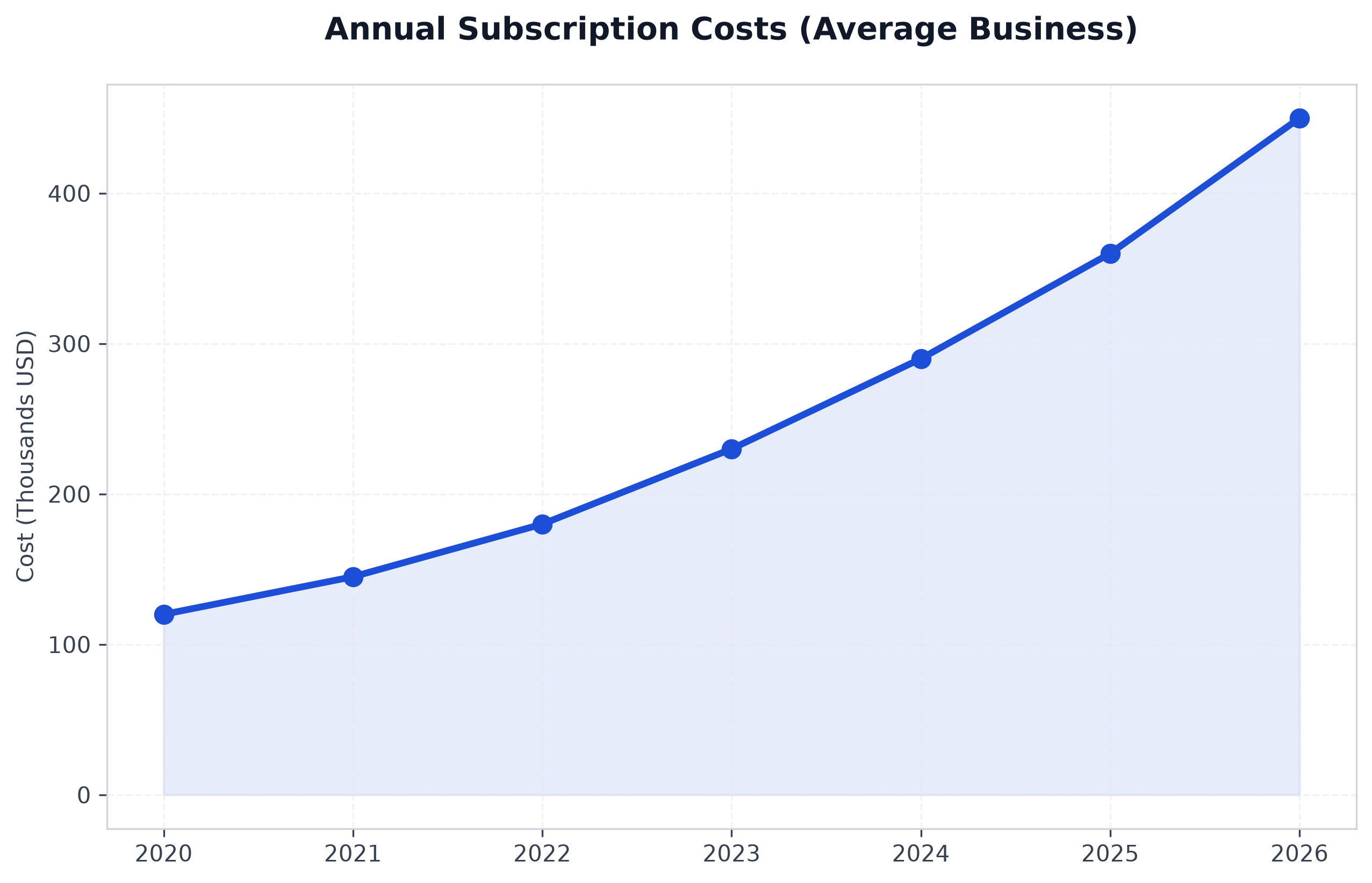
This digital land lease problem scales dramatically in organizations, expanding the digital land lease footprint. According to BetterCloud, the average business officially manages about 106 SaaS applications — the number IT formally acknowledges. The 2026 Zylo SaaS Management Index, analyzing more than $75 billion in real spending, puts the actual number at 305 applications when tools purchased by individual departments are included — and up to 696 applications in enterprises above 10,000 employees.
The nearly three-fold gap between 106 and 305 is not a measurement error. It reveals that the average organization’s IT department formally controls only about 13% of all SaaS in use; the remaining 87% is ungoverned territory, accumulating silently in each department. Organizations underestimate their application count by up to 1.7× and overspend by up to 3×, generating approximately $90 billion in annual global waste from purchased-but-unused licenses.
McKinsey described the downstream effect vividly: organizations are paying for five employees but extracting the productivity of four — the fifth is lost inside the matrix of tools bought to make everyone faster, as noted via SpeakWise. More striking: 55% of employees admit their daily tools duplicate functions from other departments — yet 79% of businesses have never acted to consolidate. Waste is not the exception; it is the default state of a system with no single accountable owner.
Asymmetric Lock-In: Clause 3 of Your Digital Land Lease
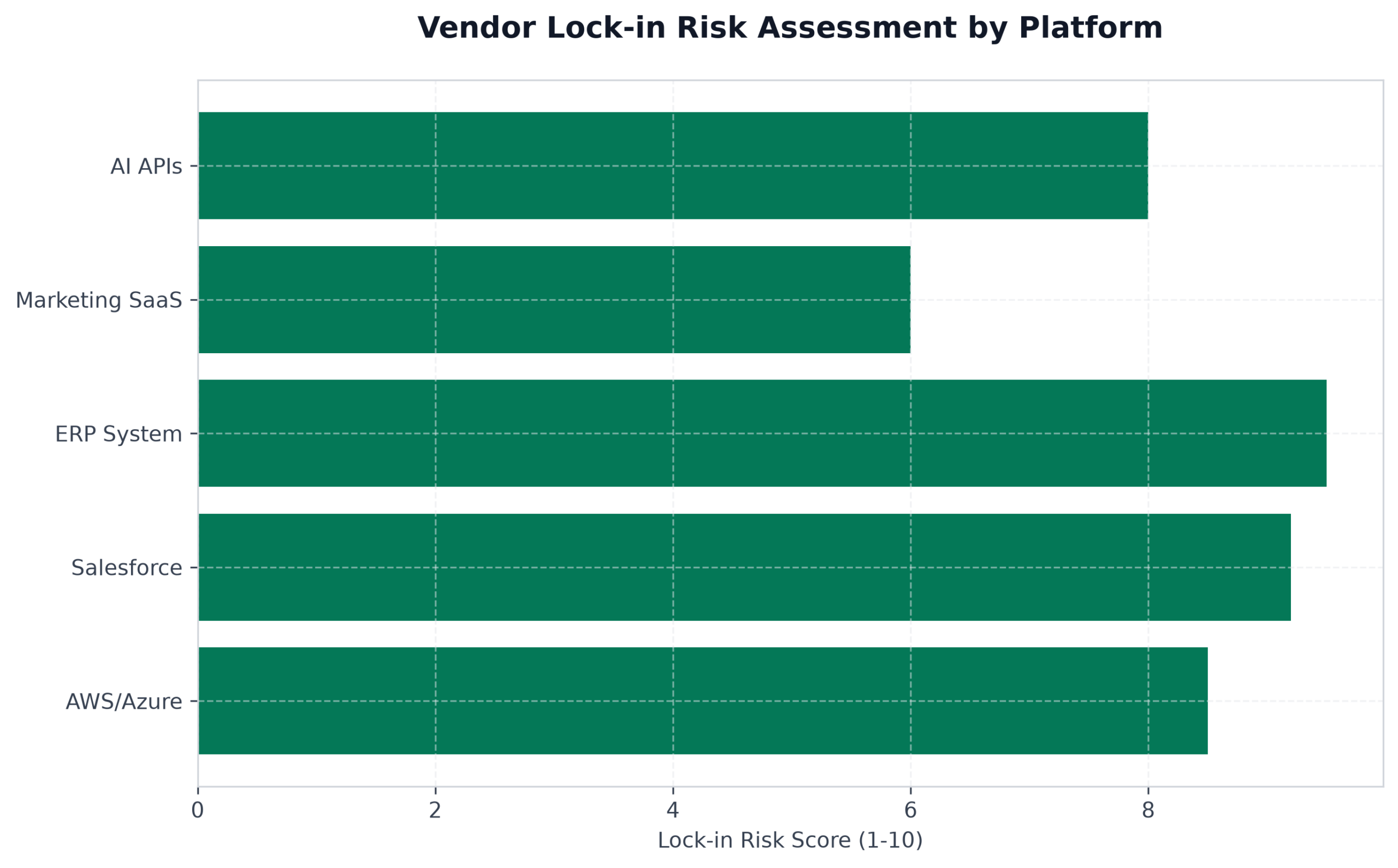
Traditional SaaS locks users into a digital land lease through data gravity and switching costs. AI-native SaaS locks users in through something deeper: personalized behavioral history. An AI writing assistant “learns” your style; a design AI internalizes your aesthetic preferences; a coding AI adapts to your patterns. When you leave, that context stays behind. You cannot transfer a “personally optimized brain” to a competitor platform.
A Bango survey conducted in late 2025, compiled by Readless, found that the average American simultaneously holds four active premium AI subscriptions totaling approximately $66 per month. Notably, 67% of AI users rank their AI subscriptions as the most essential service they pay for — more essential than streaming or music — and 61% say they would cancel all entertainment subscriptions before giving up their AI tool. A further 53% have adopted a deliberate cancel-and-restart strategy to manage AI costs, signaling that this is a calculated, not impulsive, expenditure.
In enterprise settings, the shift toward this digital land lease model is even more visible: according to Zylo 2026, ChatGPT climbed from the 14th most-expensed app in 2023, to 2nd in 2024, to first in 2026. Spending on AI-native SaaS increased 108% year-over-year across the market, with individual platforms seeing gains of up to 393%. This creates a self-reinforcing loop absent in earlier SaaS generations: users pay rent for access and provide behavioral data that makes exit progressively more expensive with each month of use. For a deeper look at how AI tools reshape cognitive habits, see our piece on the AI productivity paradox.
The “SaaSpocalypse” — When the Landlord Trembles
If the previous three clauses of your digital land lease describe platform power over users, January 2026 revealed a layer few anticipated: the platforms themselves can be threatened by a newer layer of power. When SAP announced disappointing cloud revenue forecasts and ServiceNow reported results below expectations, the S&P 500 Software and Services index dropped 8.7% to a nine-month low — SAP lost over 16% of its value, ServiceNow fell 11%, dragging Salesforce, Adobe, and other SaaS giants downward, per analysis by Futurum Group.
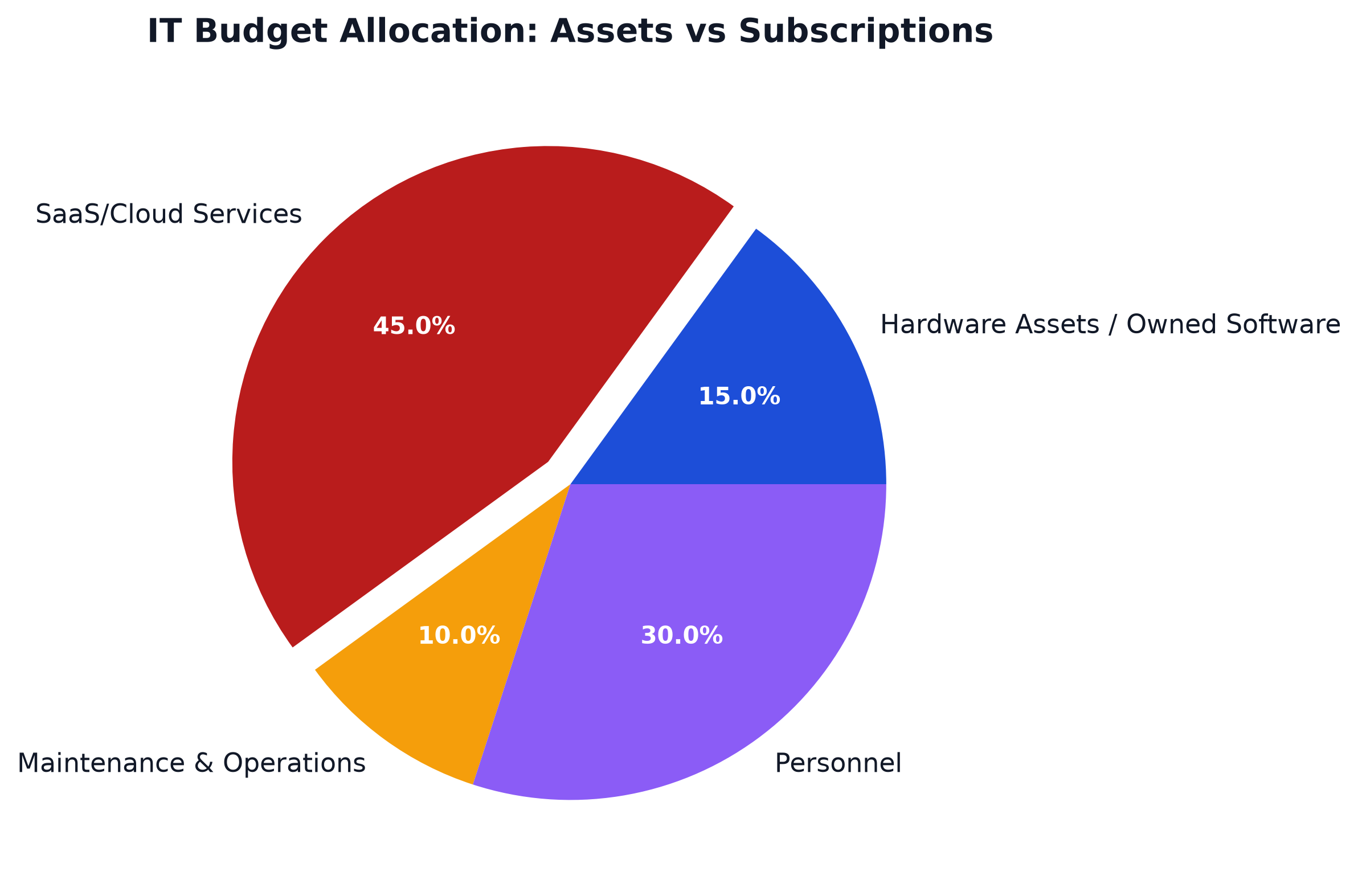
Analysts identify a structural cause: agentic AI tools — capable of executing entire workflows rather than merely assisting — are threatening the “per-seat” revenue model that underlies traditional SaaS economics. If an AI agent handles the work of several employees, organizations need fewer software seats. As SaaStr argued in “The 2026 SaaS Crash”: SaaS is not being killed — it is being starved. The technology budget is not disappearing; it is flowing in a different direction.
That direction is AI infrastructure at unprecedented scale: major technology companies are expected to spend over $470 billion on AI infrastructure in 2026. Paradoxically, this pressure has driven SaaS merger-and-acquisition activity up over 100% year-over-year, reaching $89 billion, according to PitchBook data synthesized by Fortune. The landlords are not disappearing — they are rebranding. The new layer of lords controls both the “fuel” (training data) and the “tools” (AI models) that power the very digital land users are cultivating.
The Right to Annul — How Tenants Are Fighting Back
If the four previous clauses of the digital land lease describe an oppressive architecture, this one shows that the architecture is being contested with specific legal instruments — not just individual complaints. In September 2025, Amazon agreed to pay a total of $2.5 billion — $1 billion in civil penalties and $1.5 billion in user refunds — to settle US Federal Trade Commission (FTC) allegations that Amazon Prime’s design made cancellation deliberately difficult, per PageAuditors. This is the largest “dark pattern” fine in industry history.
The fine did not emerge in isolation. In October 2024, the FTC issued its “Click-to-Cancel” rule, requiring that canceling a subscription be as simple as subscribing. The rule took partial effect in early 2025 but was overturned by the 8th Circuit Court of Appeals in July 2025 — not for substantive errors, but for procedural rulemaking flaws, per Goodwin Law. In March 2026, the FTC formally reopened the rulemaking process to draft a revised version, per Wiley Law. Across the Atlantic, the UK Department of Business and Trade estimates approximately 10 million of the country’s 155 million active subscriptions are “unwanted,” costing consumers £1.6 billion annually, per World Finance.
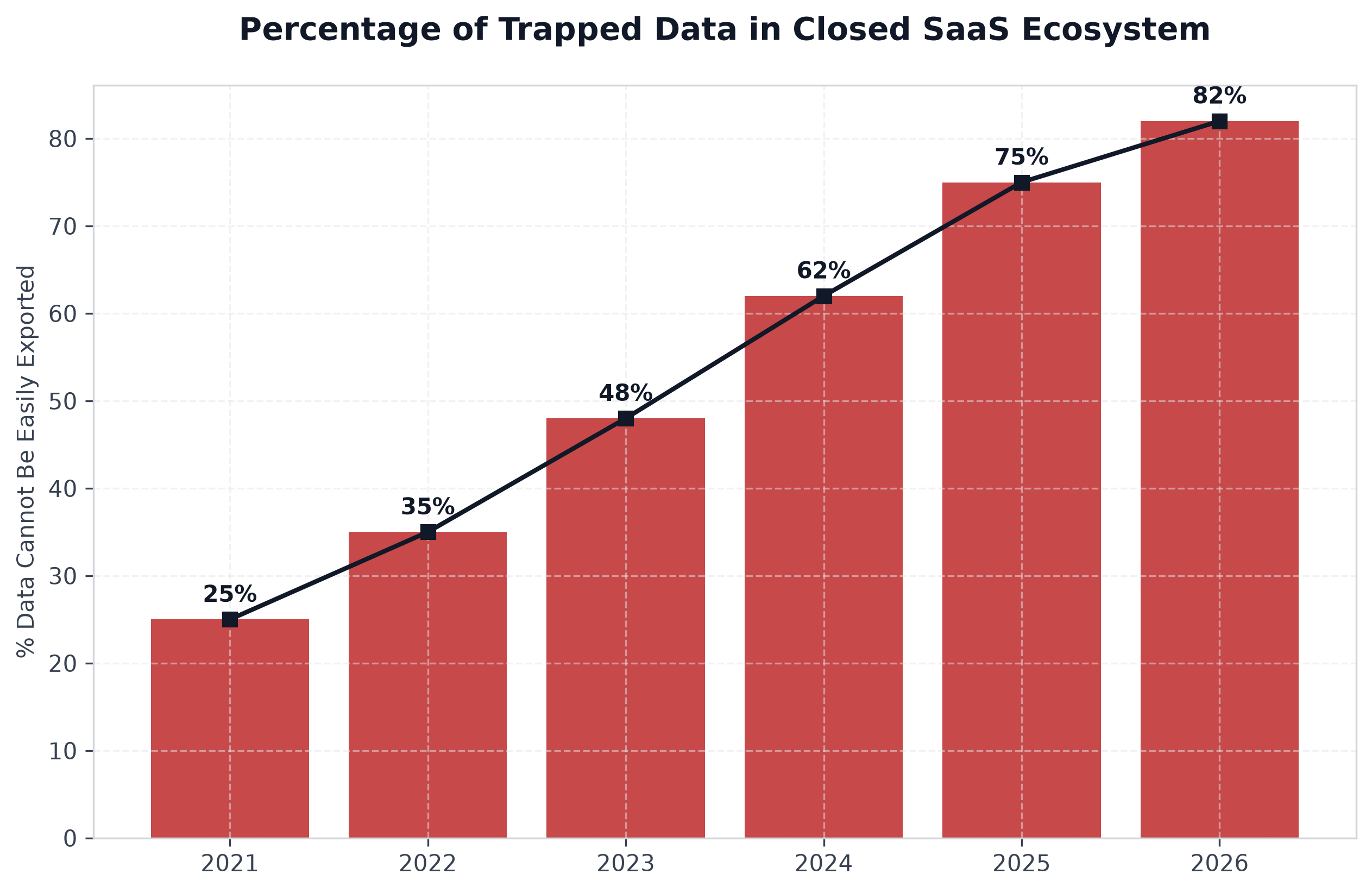
A $2.5 billion fine is large enough to reshape industry behavior regarding the digital land lease. It demonstrates that consumer power lies not in individuals leaving a platform — which the first four clauses show to be structurally difficult — but in collective pressure through regulators and law.
Timeline: The Click-to-Cancel Legal Battle
- October 2024 — FTC issues Click-to-Cancel rule.
- Early 2025 — Rule takes partial effect.
- July 2025 — 8th Circuit Court of Appeals overturns the rule due to procedural errors.
- September 2025 — Amazon agrees to $2.5 billion settlement in Prime case.
- March 2026 — FTC formally reopens rulemaking process for revised version.
Your Rights Under This Contract
The five clauses of this digital land lease are not an immutable sentence. You can rewrite your digital land lease. They describe a power structure — and every power structure, no matter how elaborately designed, has points of leverage: reviewing your own statements, questioning the true value of each package you pay for, and tracking the legal changes moving through regulators this year.
The sixth clause is not part of any platform’s terms of service. It is written by the reader — who, having seen the five clauses clearly, chooses to read more carefully before clicking “Register Now” next time.
A practical starting audit:
- Open your bank statement — list every recurring charge under $25/month
- For each service: when did you last use it purposefully — not just open it, maintaining the digital land lease?
- For AI tools specifically: which one do you depend on behaviorally, not just rationally?
- Check data portability: can you export your data from each key platform before you need to?
- Set a calendar reminder — quarterly subscription reviews are far more effective than one-time audits
Frequently Asked Questions
Find answers to the most common questions about digital land rental agreements, SaaS subscription traps, and protecting your data assets.
What is a “digital land lease”?
A digital land lease is a metaphor describing the relationship between SaaS platforms and their users. Like agricultural tenants, users do not own the “land” they cultivate daily — their data, accounts, documents, and workflows — but hold temporary access rights contingent on continued payment. The longer they stay, the higher the cost of leaving.
What is “SaaSpocalypse”?
SaaSpocalypse is the term financial media used for the sharp software-sector stock decline in late January 2026, triggered by investor fears that agentic AI tools would erode the per-user pricing model underpinning traditional SaaS economics. Most analysts, including SaaStr, characterize it as a budget reallocation to AI infrastructure rather than a systemic collapse of the SaaS model.
Why do I always underestimate my subscription spending?
Each charge is fragmented into small amounts — typically under $20 — billed monthly across many platforms. The brain does not naturally aggregate small recurring costs the way it processes a single large expenditure. This is a documented cognitive pattern, not a personal failure — and it is by design.
Is the FTC’s “Click-to-Cancel” rule currently in effect?
Not in its original form. The 8th Circuit Court of Appeals vacated the rule in July 2025 due to procedural errors in the rulemaking process — not because the rule’s substance was flawed. The FTC reopened the drafting process in March 2026. The FTC continues to pursue specific violations under existing law, as evidenced by the $2.5 billion Amazon Prime settlement.
Is AI causing the SaaS model to collapse?
No consensus exists yet. Some analysts argue agentic AI will reduce per-seat demand; others (including SaaStr) see it as a budget reallocation rather than model death — evidenced by SaaS M&A activity increasing over 100% year-over-year even as stock prices fell. The more likely outcome: SaaS survives but shifts toward outcome-based and usage-based pricing models.
What can I do to reduce my “recurring digital tax”?
The most effective first step is comparing your actual bank statement against your list of active subscriptions — the gap is almost always larger than expected. Quarterly reviews (not one-time audits) are consistently more effective. For AI tools specifically, identify which ones you depend on behaviorally, not just rationally — those are the subscriptions worth keeping; the others are candidates for cancellation.
Nếu bạn thích bài viết này, hãy để lại email hoặc bình luận để chúng ta cùng trao đổi thêm.