
AI for Small Businesses in 2026: Productivity Breakthrough or Homogenization Trap?
For lean operators or small business owners, time remains the most finite and decisive asset. Amidst the relentless artificial intelligence boom, promises of utilizing AI for small businesses to “dramatically reduce repetitive work” have exerted a magnetic pull. This has triggered a large-scale tech race, with businesses rushing headlong to deploy chatbots and automated workflows (agentic workflows).
Data from the U.S. Chamber of Commerce & Teneo report reports that generative AI adoption among small entities has surged to 58%, up significantly from 40% in 2024 and dwarfing the 23% recorded in 2023.
The JPMorgan Chase Institute also notes a corresponding spike in SME spending on AI services, with a distinct trend toward stacking multiple integrated tech solutions simultaneously.
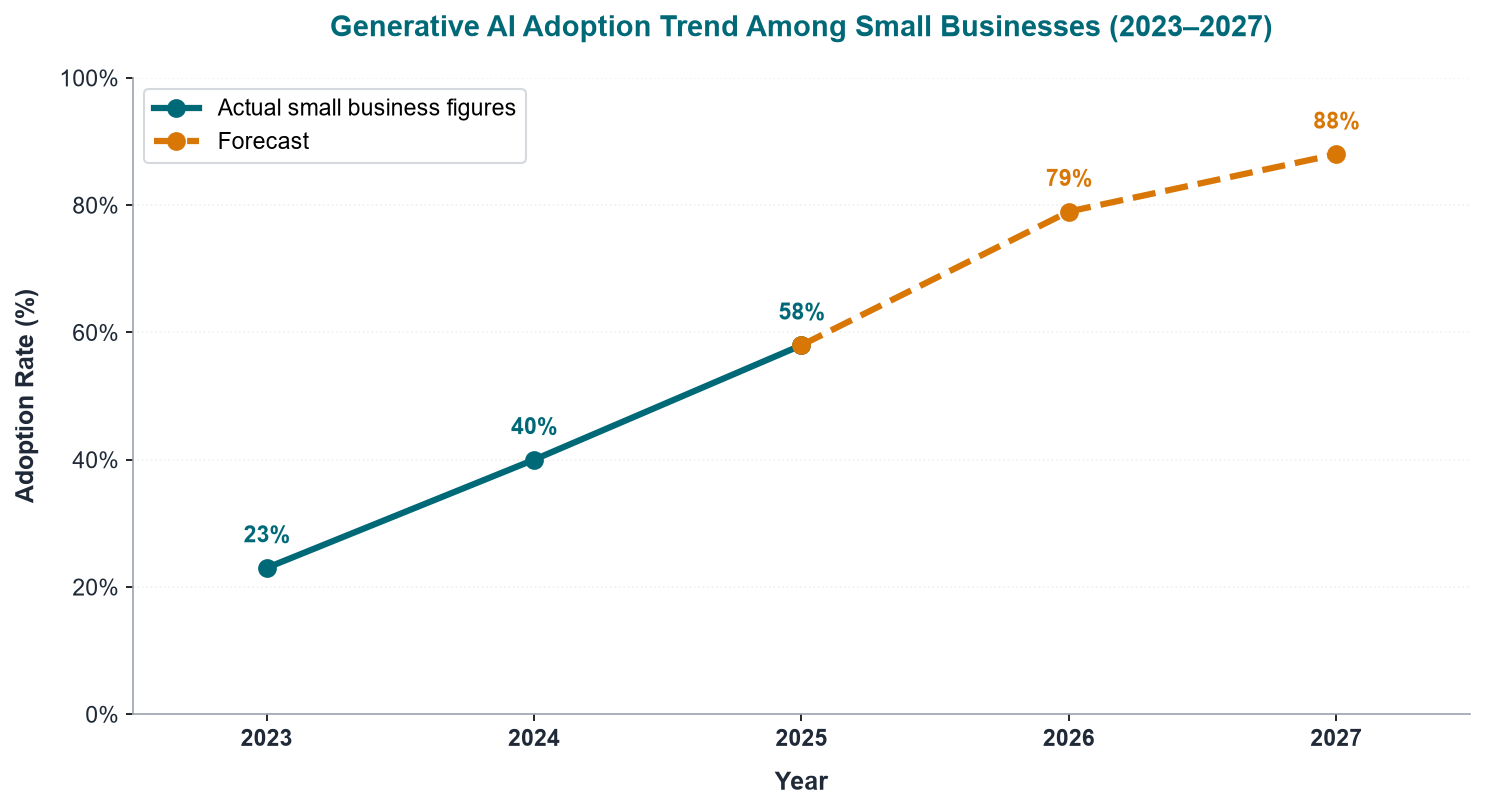
Generative AI Adoption: Generative AI adoption among small entities is rising sharply year over year, reflecting an increasingly deep integration of technology into daily operations.
Data sources: U.S. Chamber of Commerce / Teneo small-business reports (2023: 23%, 2024: 40%, 2025: 58%). *Forecasts: 2026 = 79% based on Goldman Sachs small-business AI usage + near-term adoption intent; 2027 = 88% as a modeled continuation toward the strong adoption-intent ceiling reported by U.S. Chamber / Teneo.
Yet, the strategic question persists: is AI a genuine productivity lever or merely a glorified tool? This analysis dissects the AI landscape for AI for small businesses in 2026: identifying high-ROI touchpoints while exposing five critical risks (including “Workslop,” brand homogenization, shadow AI, expectation inflation, and legal liabilities) before outlining a 5-stage roadmap for sustainable mastery.
AI Governance: A structured framework of rules, policies, and review processes that controls how AI is built, deployed, and audited within an organization.
1. Where is AI Actually Generating Core Value for Small Businesses?
In small-scale environments with thin staffing and tight budgets, a clear division between departments is often a distant dream. A single individual must wear multiple hats—handling marketing, closing sales, and resolving customer complaints all at once. In this intense cycle, AI emerges not to replace humans but to act as a sophisticated “Omni-Assistant,” optimizing every operational touchpoint.
By 2026, AI has broken free from passive, reactive chatbots. The technology has evolved into Agentic Workflows (autonomous agent workflows). Instead of waiting for fragmented commands, these systems can now autonomously extract data, analyze context, and seamlessly coordinate specialized agents to execute decisions under human oversight.
Insights from the Intuit QuickBooks survey of 34,000 SMEs across major markets like the US, Canada, UK, and Australia confirm a pivotal turning point: core operational AI integration has rocketed from 48% to 77% in a short period.
This shift extends beyond a mere trend, directly rewriting the economic equation for businesses:
- Revenue Breakthrough: Up to 43% of early adopters report powerful profit surges.
- Time Reclamation: GenAI applications reclaim an average of 5.6 to 7.2 hours per week for each employee, effectively “gifting” them a whole extra work day each week.
Reclaiming 15% of the time previously wasted on repetitive tasks serves as the strategic “fulcrum,” allowing the team to focus their intellect on core values that define brand identity. To concretize this roadmap, the following matrix identifies key touchpoints that AI for small businesses can deploy to scale productivity:
| Applied Domain | Role of AI (2026 Era) | Practical Value (ROI) | Human-in-the-Loop Oversight |
|---|---|---|---|
| Marketing & Content | Outlining mindmaps; custom ad styling; mass-producing SKU descriptions. | Saving 70% of rough drafting; maintaining continuous brand presence. | Injecting unique personality; auditing for facts and machine-generated hallucinations. |
| Sales & Commerce | Capturing and summarizing meeting intelligence; drafting email responses based on conversational context. | Ending manual documentation drain; doubling the deal-closing velocity. | Final verification of pricing structures and contractual nuances before official dispatch. |
| Customer Service | Automating FAQ triage; prioritizing escalation via sentiment analytics. | Instant 24/7 availability; slashing reactive support burdens by 60% for staff. | Direct human intervention for high-friction complaints or complex financial errors. |
| Knowledge Packaging | Structuring SOP drafts; distilling fragmented minutes into actionable task flows. | Converting individual expertise into organizational intellectual property for onboarding. | Mapping execution accountability; managing variables beyond algorithmic logic. |
| Finance & Control | Automated invoice data extraction; expense classification and payment alerts. | Minimizing clerical errors; early forecasting of cash flow volatility. | Validating numerical integrity before final disbursement approval. |
2. The GIGO Phenomenon: AI as a Mirror of Chaos
Artificial intelligence serves as an unforgiving lens, magnifying the organizational flaws a business has neglected. This reality is anchored in a classic principle: GIGO — Garbage In, Garbage Out.
Many small business owners have prematurely offloaded SOP architecture to AI. While tools can generate polished, professional text within seconds, these often remain hollow plans, completely detached from the actual operational context of the organization.
- An opaque post-purchase policy traps AI into providing incorrect yet authoritative customer guidance (the hallucination trap).
- Fragmented input datasets lead to compromised strategic insights, risking business decisions.
- Absent quality benchmarks trigger the industrial-scale proliferation of low-value content without an evaluation filter.
Before automating a workflow, ask a simpler question: “Is the process already stable enough to automate?” The key to success for AI for small businesses lies in crystallizing core values before authorizing algorithms to execute.
3. Workslop and Hidden Costs: When AI Becomes an Operational Burden
While heightened technological literacy has propelled small businesses toward near-universal AI access, the post-honeymoon phase yields a harsh reality: indiscriminate AI utilization does not equate to a smoother operational machine.
Key Definitions:
• Workslop: Output streams—from emails to media assets—that project a polished veneer while remaining intellectually hollow, context-blind, and ultimately failing the recipient’s core problem.
• Botsitting (Term by Glean Work AI Institute): A cycle where humans are trapped acting as machine supervisors, losing an average of 6.4 hours per week desperately injecting the context and data verification required to turn algorithmic outputs into something of practical value.
While deep behavioral studies on this phenomenon are typically measured at the enterprise scale, the operational vulnerabilities they expose serve as a highly costly early warning for lean teams. Findings from the Harvard Business Review confirm that 40% of surveyed U.S. workers—per BetterUp Labs and Stanford—reported receiving workslop buzzwords in the past month. Unlike enterprise-scale firms with the financial buffers to absorb such friction, lean operations find that this productivity drain directly erodes their strategic lifeblood. Although these studies focus primarily on larger organizations, the underlying operational failure modes—manual verification, context switching, and governance overhead—can also emerge in lean businesses as AI adoption scales.
The data exposes these perilous hidden liabilities:
- A report from the Zapier survey on enterprise data notes that talent in mid-to-large organizations sacrifices an average of 4.5 hours weekly to manually error-correct AI outputs; a mere 2% of practitioners can trust raw output without manual intervention.
- The Glean Work AI Institute reports that workers lose an average of 6.4 hours per week to this “botsitting” cycle, desperately trying to make algorithmic outputs usable.
To liberate teams from this “virtual productivity mirage,” operators must pivot their evaluative frameworks (KPIs):
| Virtual Metric (Discard) | Real Value (Measure) |
|---|---|
| Gross volume of AI-generated sales emails. | Actual conversion velocity and positive customer sentiment. |
| Total sessions managed autonomously by chatbots. | CSAT benchmarks and customer retention integrity. |
4. The Homogenization Trap: Losing Your “Brand Voice”
When skimming a marketing campaign or blog post and instantly recognizing it was authored by a machine, you are witnessing the surface of a larger crisis: Brand Homogenization.
Architecturally, large language models (LLMs) operate on the principle of converging toward the highest-probability linguistic sequences. Consequently, their tone tends to be neutral, safe, and devoid of edge. If a business relies entirely on algorithms for content production, they are voluntarily blending their brand voice into the generic mainstream.
This phenomenon leads to two practical consequences for small businesses:
- Eradicating Core Competitive Advantage: Unlike large corporations with massive budgets to maintain presence through ad frequency, a lean team’s greatest assets are its local authenticity, agility, and the unique personality of its founders. Copy-pasting AI text inadvertently flattens these distinct edges, turning the brand into a pale imitation of competitors who are also using the exact same AI models.
- The Trust Deficit: The Edelman Trust Barometer has warned of rising consumer skepticism toward emotionless automated systems. Modern readers possess a natural, highly sensitive filter for hollow content (workslop); they will quickly abandon brands that fail to deliver real informational value or human experience.
To protect the “Authenticity Premium,” businesses must establish “Brand Persona Guidelines” as a rigid contextual framework before allowing AI to enter the drafting process:
- Define an Independent Worldview: Clearly outline the industry perspectives or non-negotiable value systems of your business that no AI model can spontaneously assume.
- Localize the Language: Use the exact terminology, real-world experiences, and tone that your target audience actually uses in real-life conversations.
- Create a “Banned Words” List: Rigorously filter and eliminate clichéd AI buzzwords (such as breakthrough, holistic, elevate, in the digital era…) to maintain sharp, concise messaging.
5. Expectation Inflation: Speed as the New Baseline
Artificial intelligence has accelerated customer interactions to a near-instantaneous baseline. However, in a market where every competitor can respond instantly via chatbots, speed is no longer a sharp weapon for breakout performance; it has been downgraded to a minimum required condition (a commodity).
This triggers the paradox of user expectation inflation. When time is flattened by algorithms, customers pivot toward values machines cannot simulate: deep empathy, nuanced personalized context retention, and the capacity to handle edge-case variables with human-to-human respect.
Prematurely offloading communication to machines carries heavy liabilities. The Sinch survey 2026 AI Production Paradox report—drawing on 2,527 enterprise decision-makers—found that 74% of organizations that deployed an AI customer communications agent in production have since rolled it back. The primary triggers: concerns about customer data exposure (31%), hallucinations or brand risk (22%), and lack of auditability (16%). While this data reflects large-scale deployments, the failure modes are highly relevant.
For AI for small businesses, agility and authenticity outperform scale. Do not let soulless automation alienate your base; otherwise, you do not just close a ticket—you permanently sever user trust.
6. Legal Risks: Big Firms Suffer Scratches, Small Businesses Face Extinction
Unlike large corporations with bulky legal teams acting as risk filters, small businesses will bear the full brunt of legal and financial consequences if AI causes a serious error.
This risk is most dangerous when a business falls into a state of losing control due to Shadow AI—a phenomenon where employees use personal AI tools for company work without management’s knowledge.
A PagerDuty survey points to an alarming reality: 2/3 of enterprise office workers admit they secretly use AI tools at work despite company prohibitions or lack of approval.
The consequences are severe: Harmonic Security’s report reveals that over 4% of prompts and nearly 22% of files across enterprise deployments uploaded to public AI platforms in the past year contained extremely sensitive business data. From pasting confidential partner emails to uploading internal financial reports for summarization, you are exposing your business secrets to the world.
Furthermore, there is the risk of losing intellectual property. Rulings from regulators (such as the U.S. Copyright Office) have affirmed: Content, source code, or images created entirely by AI from standard prompts will not qualify for copyright protection. If the content is purely raw output from a prompt, you strip yourself of the legal weapons needed to protect your assets from competitor replication.
Establish a risk governance corridor immediately using the classification table below:
| Risk Level | Applicable Task Scope | Required Control Process |
|---|---|---|
| LOW | Outlining articles, internal brainstorming, and drafting social media posts. | Basic Review: Staff are responsible for checking spelling and appropriateness before publishing. |
| MEDIUM | Customer email replies, product descriptions, chatbot support scripts. | Fact-check: Mandatory check on technical specifications and brand tone accuracy. |
| HIGH | Setting price lists, internal regulations, and financial reports and handling financial complaints. | Drafting Assistant: AI only drafts the raw version. Qualified humans must review deeply and sign off. |
| VERY HIGH | Customer identification data, confidentiality contracts, and bank account info. | Tool Freeze: Strictly prohibited to upload data to free, public AI platforms not approved for security. |
*Disclaimer: The above analysis is based on the current legal landscape in major international markets and does not constitute corporate legal advice.
7. A 5-Stage Strategy for Safe AI Deployment in Lean Businesses
True institutional readiness stems from an organization’s knowledge digitalization capacity rather than mere subscription volume. For high-fidelity execution, prioritize this digital axiom: forego the frantic app chase and instead crystallize the structural gaps within your current operations.
An optimal framework for algorithmic scaling of AI for small businesses must satisfy these five strategic benchmarks:
- High frequency and operational repetition.
- Alignment with safe risk-exposure thresholds.
- Human expertise capable of stringent quality auditing.
- Availability of high-fidelity “Gold Standard” reference data.
- Quantifiable performance through rigorous KPI mapping.
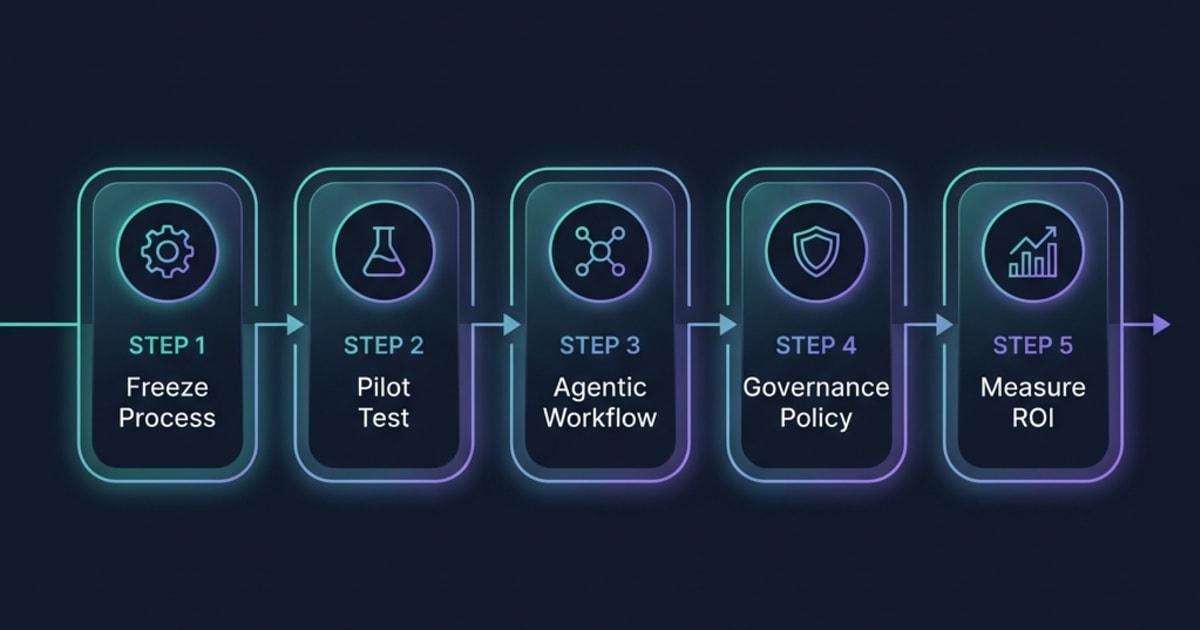
Phase 1: Analyzing and “Packaging” Micro-Workflows. Leadership must audit the “as-is” operational landscape: codifying accountability, temporal requirements, and output benchmarks. Initially, bypass high-friction variables like financial forecasting or HR governance.
Phase 2: Validating Performance via 10 Scenario Stress Tests. Deploy 10 historical cases; sanitize all PII to insulate the entity from data liabilities. Measure the delta between AI drafting and the “botsitting” overhead. Process scaling is only merited when total cycle time decisively outperforms legacy methods.
Phase 3: Pivot from Static Prompts to Agentic Workflows. Fragmented prompting offers only ephemeral utility; sustainable leverage requires a structured agentic workflow. Replace manual reliance with an automated execution architecture:
- Trigger: Autonomous detection and analytical triage of critical customer friction.
- Action: Agentic retrieval of historical context to draft SOP-aligned resolution strategies.
- Review Loop: Algorithmic validation precedes final human sign-off, ensuring contextual integrity.
Phase 4: Codifying the “Minimalist Governance Corridor.” Lean entities require clarity over complexity. Distill your risk strategy into a single-page mandate addressing three pivotal pillars:
- Approved Tooling: Formal authorization of specific applications within the operational stack.
- Data Sovereignty: Explicit classification of shareable vs. strictly proprietary intelligence.
- Accountability Matrix: Defining legal responsibility for synthetic output (Principle: AI drafts, human commits).
Phase 5: Evaluation via Real ROI Matrix. Stop measuring productivity based on prompt volume or output quantity. Real surplus value must be dissected through the quality of the value chain:
| Operational Touchpoint | Virtual Metric (Discard) | Practical Value (Measure) |
|---|---|---|
| Sales & Support | Number of machine-generated ad emails. | Conversion rate and accurate response speed. |
| Customer Support | Total automated support sessions. | Resolution time and CSAT scores. |
| Digital Marketing | Total volume of published articles. | Indexing rate and information value for readers. |
Operational AI Checklist for Lean Teams
- Audit the process first: Never automate a chaotic or undocumented workflow.
- Establish data guardrails: Explicitly ban employees from uploading PII or trade secrets to public models.
- Design multi-agent workflows: Let Agent B critique Agent A’s output before human approval.
- Retain the Authenticity Premium: Infuse your founder stories and local context into every customer-facing output.
- Measure ROI on outcomes: Track conversion rates and resolution speed, not AI output volume.
8. Conclusion: AI is an Amplifying Lens, Not a Cure-All
Circling back to the strategic question: Is AI a breakthrough lever or a homogenization trap? The solution lies entirely in the operator’s systems thinking.
In an era where anyone can generate polished content, quantity has become a devalued commodity. The only existing surplus value is the appraisal capacity of human intelligence and the absolute advantage of genuine empathy.
The leading businesses of 2026 will stand out by leveraging technology to systematically remove operational bottlenecks, thereby freeing up resources for genuine, human-to-human interaction.
Do not start your journey by searching for the latest trendy tool. Instead, begin by optimizing the workflows already running in your office. To continuously expand your mindset and adapt to the evolving AI landscape, explore our latest insights and resources or dive deeper into our practical guides to learn how to master these technological shifts.
Frequently Asked Questions
Find answers to the most common questions about deploying artificial intelligence, managing agentic workflows, and securing data assets in lean teams.
How can AI actually improve productivity for lean teams?
Why is “Workslop” a critical threat to small businesses?
How do you prevent AI from flattening your brand voice?
What is the most immediate legal risk of using AI?
{ “@context”: “https://schema.org”, “@graph”: [ { “@type”: “Article”, “headline”: “AI for Small Businesses in 2026: Productivity Breakthrough or Homogenization Trap?”, “description”: “AI for small businesses in 2026 can unlock productivity or fall into the homogenization trap. Discover the practical deployment playbook with agentic workflows.”, “author”: { “@type”: “Person”, “name”: “Desmond L.Nguyen”, “url”: “https://techandmindsetlab.com/about” }, “publisher”: { “@type”: “Organization”, “name”: “TechAndMindSet Lab”, “url”: “https://techandmindsetlab.com” }, “mainEntityOfPage”: { “@type”: “WebPage”, “@id”: “https://techandmindsetlab.com/ai-for-small-businesses-2026/” } }, { “@type”: “FAQPage”, “mainEntity”: [ { “@type”: “Question”, “name”: “How can AI actually improve productivity for lean teams?”, “acceptedAnswer”: { “@type”: “Answer”, “text”: “By executing structured, high-repetition tasksu2014like summarizing meetings, drafting SOPs, and triaging support tickets. The key is deploying AI as a functional assistant, not a strategic replacement, ensuring humans remain in the loop for quality control.” } }, { “@type”: “Question”, “name”: “Why is “Workslop” a critical threat to small businesses?”, “acceptedAnswer”: { “@type”: “Answer”, “text”: “Workslopu2014polished but intellectually hollow AI outputu2014creates a “botsitting” trap. Instead of doing deep work, teams waste hours manually editing and injecting context into generic drafts, directly cannibalizing the time AI was supposed to save.” } }, { “@type”: “Question”, “name”: “How do you prevent AI from flattening your brand voice?”, “acceptedAnswer”: { “@type”: “Answer”, “text”: “Before generating any content, enforce a strict “Brand Persona Guideline.” This means actively blocking clichu00e9d AI buzzwords (like “in the digital era” or “holistic”), explicitly feeding the model your unique founder perspectives, and ensuring the final polish sounds authentically human.” } }, { “@type”: “Question”, “name”: “What is the most immediate legal risk of using AI?”, “acceptedAnswer”: { “@type”: “Answer”, “text”: “Shadow AI and data leakage. If employees routinely paste proprietary data or client information into unauthorized, public AI models, they violate confidentiality. Additionally, purely AI-generated text or code enjoys zero copyright protection, leaving your intellectual property vulnerable to direct competitor replication.” } } ] } ] }
Nếu bạn thích bài viết này, hãy để lại email hoặc bình luận để chúng ta cùng trao đổi thêm.